

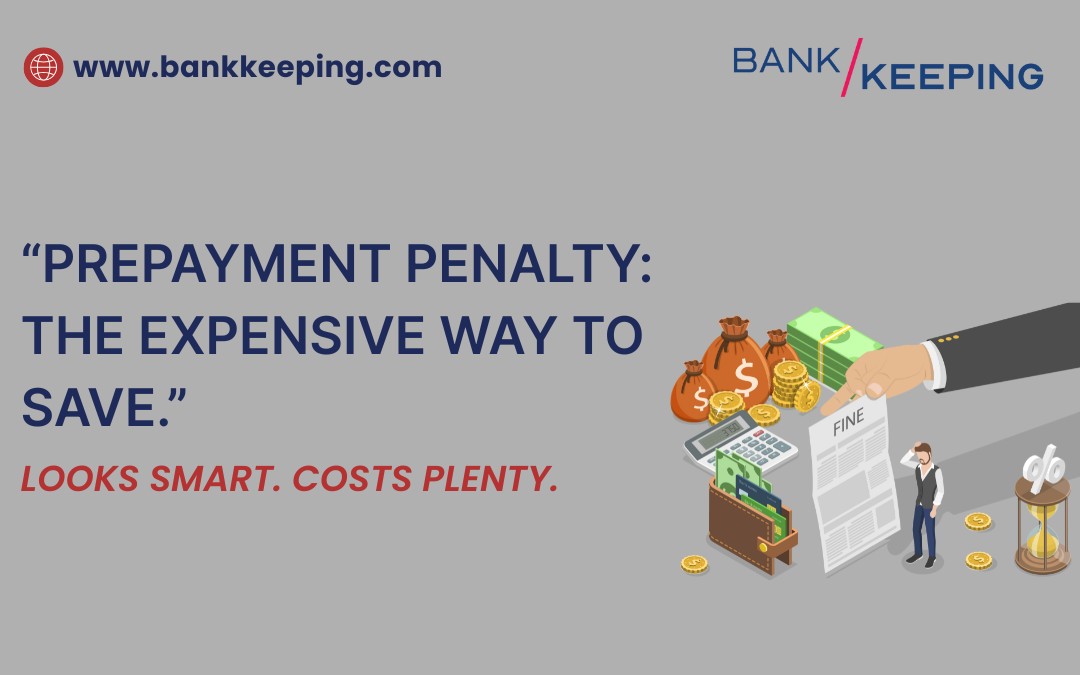
A borrower borrows funds from Banks & Financial Institutions to meet its business needs and the same needs to be repaid over a pre-determined time period; however, at times, the borrower has surplus funds and intends to repay the Bank loan a little earlier. This is called “Prepayment of Loans.”
This looks good and simple. However, practically, it has its own set of challenges and one needs to be careful in planning about it
Prepayment Penalty Charged by Banks
Banks will charge a prepayment penalty if the business loan is terminated earlier – This may look a little surprising since you are clearing bank dues in advance and not making it NPA. So, instead of being rewarded, one is being penalized.
The logic given by banks is that once they have sanctioned a particular limit / loan amount to a borrower – they have earmarked those specific funds to a particular customer for a specific agreed tenure. They shall not be able to deploy this fund elsewhere. However, in the case of prepayment, their internal cash flows and profitability gets distorted temporarily and they need to identify another borrower where the surplus funds need to be parked. In the interim period, the bank may lose some interest income and hence they charge prepayment penalty so as to compensate them for the aforesaid loss.
Also, at times, to discourage customers to shift to another bank – they charge prepayment penalty as a deterrent.

Cautions for Prepayment of Business Loans
Pre-Payment Clause
So, how should an MSME borrower prepare itself / handle this situation? While accepting the Sanction Letter – one needs to delve into the pre-payment clause and ensure that the clause is modified properly in the following lines:
- Prepayment Penalty should be applicable only on the outstanding amount (not sanctioned amount). Example – If you have borrowed Rs. 10 Crore and now the balance to be justified to repay is Rs. 2 crore – then prepayment penalty should be levied as % on Rs 2 crore only (and not on Rs. 10 crore).
- The rate of such penalty goes up to 4% of the total limit – which acts as a big deterrent in case you intend to shift to another lender, even for genuine reasons. Hence, a proper negotiation on this needs to be done upfront at the time of accepting the sanction letter.
- Customers should ensure that such a penalty should not be charged in case they are repaying it from their own surplus funds (and not through funding from another bank).
- Whenever a lender and borrower enters into an agreement / arrangement, it is presumed to be for a long term. However, at times, owing to no fault of the customer / poor & delayed service from bank officials – the customer intends to exit this relationship and have peace of mind. But the clause of prepayment penalty of such a hefty amount stops him from acting on the same. Hence, to overcome this situation, borrowers should plan in advance and make bankers agree that prepayment penalty should be leviable only if he terminates the relationship within a specific time period (say, a year) and not beyond that.
- If the lender keeps insisting on a longer lock-in period (more than a year), then as an escape mechanism, the borrower may convince them that in case they inform them well in advance before the renewal due date – then no prepayment penalty should be leviable. All these things should be recorded in writing.
- Ideally, prepayment penalty should be charged only on Term Loan and not on Working Capital Loans (though sanctioned for a year, since these are demand loans and repayable as & when demanded by a bank). However, Banks do not agree on the same. Nevertheless, for an MSME with proper documentation & negotiation – it is possible at times to get the same waived off on working capital loan as well.
Please be noted that all such negotiations with the lender should happen at the time of onboarding / accepting the sanction letter. And secondly, everything has to be written and documented. To know more contact us here.
One thought on “Prepayment of Loans”